

University of Arizona scientists uncover a “central computer” hidden inside cells
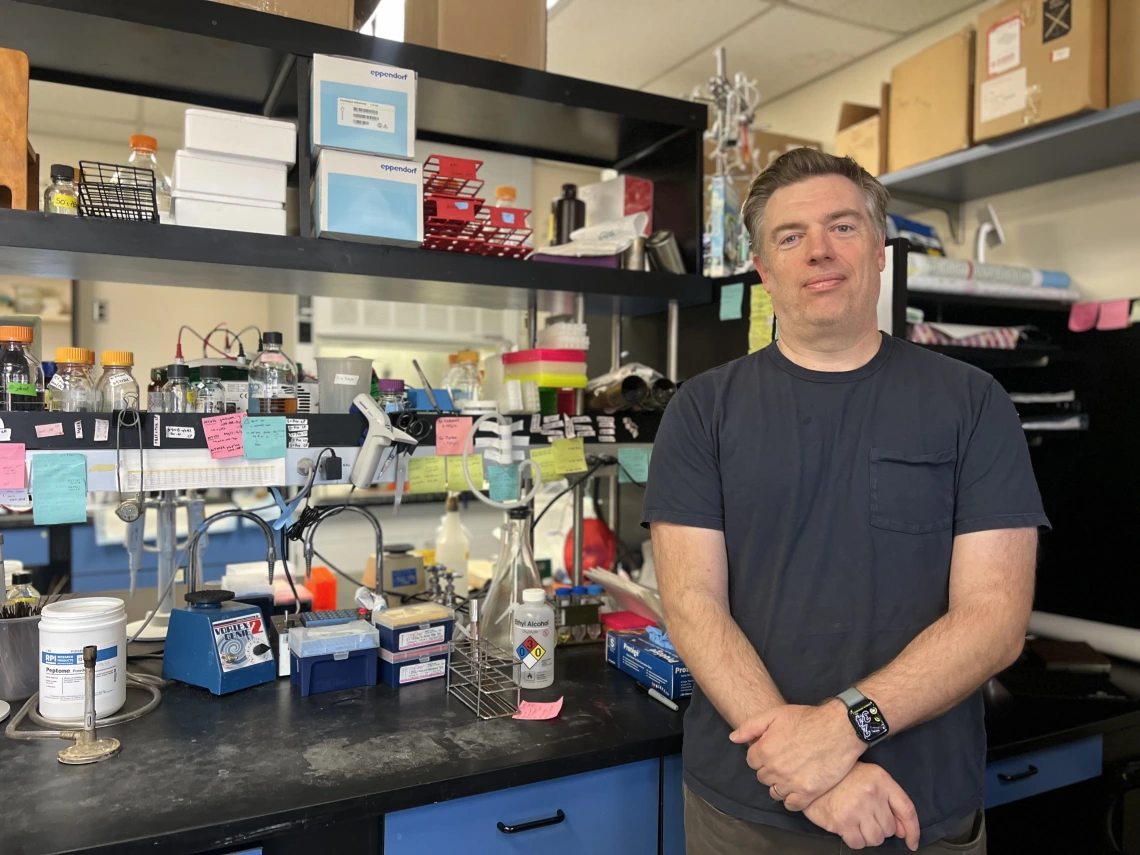
Dr. Andrew Capaldi, professor in the Department of Molecular and Cellular Biology at the University of Arizona.
For decades, biologists have known that a protein complex called TORC1 acts as a master regulator of cell growth—turning growth programs on when nutrients are available and shutting them down when conditions worsen.
Now, a new study conducted at the University of Arizona reveals that TORC1 is far more sophisticated than previously believed. Instead of functioning as a simple on and off switch, TORC1 behaves more like a central computer that integrates different signals and then selectively turns specific pathways on and off--tuning metabolism, energy-intensive processes and cell division, all in real time.
The discovery, led by Dr. Andrew Capaldi, a professor in the Department of Molecular and Cellular Biology, helps explain how a single protein complex can influence such a wide range of human conditions, from aging and diabetes to clinical depression, epilepsy and cancer. The research was spearheaded by graduate student Cristina Padilla, whose path from community college in Yuma to publishing a high-impact scientific paper highlights the power of opportunity and mentorship.

Padilla and Lim hold one of the many samples that helped uncover a new model of how cells regulate growth.
McKenna Manzo
Capaldi’s interest in TORC1 began during his postdoctoral work 15 years ago, when systems biology was emerging as a way to understand how thousands of proteins communicate. Instead of viewing cell signaling circuits as simple pathways, he began thinking of them as information-processing networks.
The story of TORC1 stretches back even further. In the early 1990s, scientists studying soil from Easter Island identified a molecule called rapamycin that halted the growth of yeast and human cells. Researchers then traced its mechanism to a previously unknown protein they called the Target of Rapamycin, or TOR.
Today, Capaldi’s team at the U of A is probing TORC1, a key protein complex that includes TOR, to uncover how this ancient molecular controller governs everything from aging to cancer.
TORC1: The master growth controller
Every eukaryotic organism – from fungi, to flowering plants, and humans– relies on TORC1 to decide how fast its cells grow.
“It’s the master controller," Capaldi said. “When you have nutrients and the right hormones, like insulin, TORC1 turns on and tells the cell to make all the building blocks it needs: proteins, lipids, nucleotides--everything.”
When TORC1 is active, cells grow. When it switches off, cells slow down and may enter a sleep-like state called quiescence.
Despite decades of study, many aspects of TORC1 remain mysterious. Mutations in its regulators cause epilepsy, hyperactivate the pathway in cancer, and disable it in clinical depression. Ketamine, a fast-acting antidepressant, works in part by restoring TORC1 activity in neurons.
“In depression, neurons struggle to form new synapses,” Capaldi said. “Ketamine boosts TORC1, allowing neurons to grow new connections. But too much TORC1 activity can contribute to hallucinations, which is why ketamine is also misused as a club drug.”
TORC1 is also central to aging. When nutrient levels drop—such as during prolonged fasting—TORC1 turns off, triggering autophagy, a cellular cleanup process linked to increased lifespan. Many anti-aging diets and drugs leverage this mechanism; however, Capaldi notes that suppressing TORC1 too long weakens the immune system.
A central computer hidden in plain sight
For years, scientists believed that TORC1 behaved like a dimmer switch: more nutrients simply meant more TORC1 activity. But Capaldi’s team suspected this was an oversimplification. TORC1 has at least 80 different regulatory proteins--far more than most kinases--and sensors for almost every amino acid and many other nutrients in the human body. Why would a simple growth switch need so many inputs?
The team realized that the field had largely been studying TORC1 under extreme conditions. Most experiments removed a nutrient entirely—something that rarely happens in real life—and then measured only one of TORC1’s many outputs.
To mimic real biological conditions, Capaldi’s group shifted cells from high-quality nutrients to poor-quality nutrients (not starvation) and then measured thousands of different TORC1 outputs simultaneously using mass spectrometry.
What they found fundamentally changed how TORC1 signaling is viewed.
“When we put cells in poor nutrients, almost all of TORC1’s targets changed,” Capaldi said. “About 90% of them. Then in full starvation, the remaining 10% change — and those are the ones that shut off growth.”
This result, combined with a map of the regulators that act upstream of TORC1 in each condition, revealed that TORC1 is not just a growth switch--it is constantly recalibrating metabolism, nutrient import, stress responses and biosynthesis programs, even with small changes in diet.
The team describes TORC1’s behavior as multi-layered regulation, which Capaldi broke down into DEFCON levels:
DEFCON 1: Nutrient levels dip → TORC1 slightly slows growth and boosts nutrient transporters on the cell membrane to pull in more resources.
DEFCON 2–3: Nutrient issues worsen → additional regulators reduce growth pathway activity through TORC1 and adjust select metabolic processes.
DEFCON 4: Severe starvation → a special “emergency brake” regulator shuts TORC1 off entirely and cells stop dividing.
One of the biggest shocks came when the lab tested a very famous TORC1 regulator called GATOR (or SEAC) – cells missing this complex behaved normally in moderate nutrient stress.
“We realized it’s the emergency brake,” Capaldi said. “It only acts during full starvation to shut TORC1 off. For years it looked dominant because most labs only studied total starvation.”
This new model, where TORC1 acts as a central computer toggling many pathways independently, explains why mutations in different regulators produce different diseases. Each regulator controls its own tier of the system.
Why this matters for disease treatment
Right now, scientists lump all TORC1 mutations into one category assuming they all affect the same switch. Capaldi argues that this discovery could change that.
“We predict that mutations in the first-layer regulators will cause long-term metabolic problems, things like aging and diabetes,” he said. “While defects in the emergency brake are more likely to cause cancers.”
Understanding which “layer" of the system is disrupted could allow for more targeted therapeutic strategies.
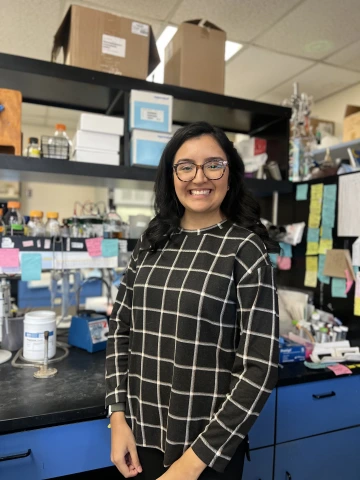
Cristina Padilla
From Yuma to a groundbreaking discovery; Padilla’s journey
The research required more than three years and immense experimental effort: 10,000–15,000 measurements in some experiments, over 100 experiments, and 40 newly engineered mutant cell lines. Graduate student Cristina Padilla led much of the work, collaborating with fellow graduate student Jeaho Lim, and mass spectrometry experts Austin Lipinski and Paul Langlais.
Padilla’s path is as compelling as the science itself.
Raised in Yuma, she attended a local community college where she became valedictorian—before transferring to the NAU Yuma campus, a satellite program with few research labs. She was not initially accepted into U of A’s graduate program but Dr. Frans E. Tax, Associate Dean of Student Success in the Graduate College, noticed her potential and admitted her through the IGERT program for students with non-traditional research backgrounds.
Padilla arrived at Capaldi’s lab three months before her program officially began, unfamiliar with many laboratory techniques but determined to learn. Through persistent training, reading and experimentation, she uncovered early hints of TORC1’s multilayered regulation and behavior.
“She’s unbelievably focused,” Capaldi said. “Now when you hear her give a talk, she sounds like a tenured professor. And she’s only four years into grad school.”
Padilla is now the first author on the Nature Communications paper, a rare achievement for someone who entered graduate school with minimal laboratory experience.
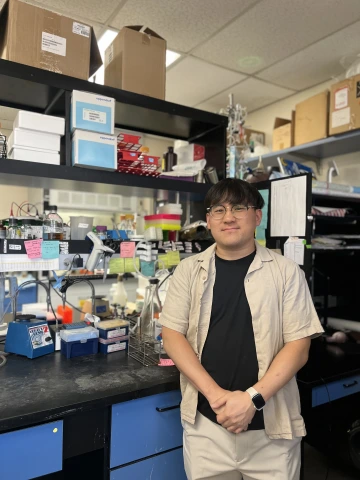
Jeaho Lim
Reflecting on the project she said:
“What changed my view of science was realizing how often you have to revise your initial model. Over the years, I learned to step back, review all the data together, and formulate the simplest hypothesis supported by the evidence.”
Padilla credits her success to Capaldi’s guidance and her own persistent nature and ability to ask questions.
“The most important things in science are getting experiments to work consistently and asking the right questions. Learning to do those things helped me ramp up in a field where I had almost no experience,” she said.
Why basic research matters and what’s next
Capaldi hopes the public takes away two messages: that cells are constantly recalibrating their internal processes and that major discoveries often depend on time-consuming basic research in simple model organisms like yeast.
“People think we understand everything after 30 years of studying a system, but we’re still just getting the basics,” he said. “And you can’t do complex studies like this in humans--you have to know what you’re looking for first.”
The team’s next step is to determine whether the same multilayered TORC1 signaling occurs in human cells.